1 Row vs. 2-Row vs. 3 Row Radiators: What's the Difference?
An automotive radiator is responsible for dissipating heat from the engine coolant, helping the engine maintain its optimal operating temperature. One of the most common questions is whether a 1 Row, 2 Row, or 3 Row radiator offers the best performance. The answer is simple: it depends on the application.
1 Row Radiator
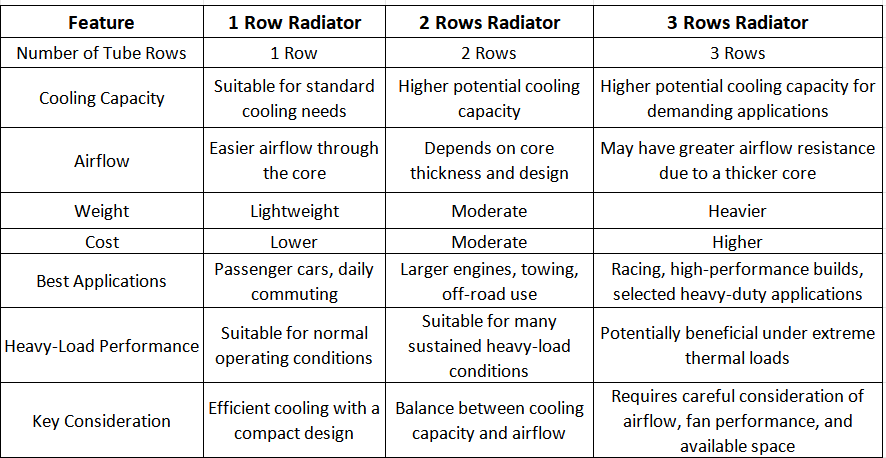
1 row radiator has one row of cooling tubes. Thanks to modern aluminum core designs and high-efficiency fins, it can provide excellent cooling performance for most passenger cars and light-duty vehicles.
Best suited for:
Small-displacement engines
Daily commuting
Standard factory vehicles
Advantages:
Lightweight
Better airflow
Lower cost
Sufficient cooling for most applications
2 Row Radiator
2 row radiator features two rows of cooling tubes, increasing the coolant capacity and heat transfer area. It is commonly used on vehicles that generate more heat or operate under heavier loads.
Best suited for:
Larger engines
Towing or hauling
Off-road vehicles
Hot climate conditions
Advantages:
Higher cooling capacity
Better performance under sustained heavy loads
3 Row Radiator
3 row radiator provides even more cooling surface area and coolant volume. It is generally designed for high-performance or specialized applications where heat generation is exceptionally high.
Best suited for:
Racing vehicles
High-performance engine builds
Heavy-duty commercial applications
Advantages:
Maximum cooling potential
Excellent performance under extreme operating conditions
1 Row vs 2 Row vs 3 Row Radiator
Is More Always Better?
Not necessarily.
While adding more rows increases cooling capacity, it also makes the radiator core thicker. A thicker core can restrict airflow, increase weight, and require more powerful cooling fans. In some cases, a well-designed 1 Row radiator can outperform an outdated multi-row design because of improved tube width, fin density, and overall airflow efficiency.
Installing a larger radiator than necessary may also increase cost without providing any noticeable benefit.
Choose the Right Radiator for Your Needs
The number of radiator rows should be selected based on your vehicle's engine size, power output, operating environment, and cooling requirements—not simply on the assumption that more rows are always better.
For most everyday passenger vehicles, a 1 row radiator is more than capable of delivering reliable cooling performance. 2 row and3 row radiators become beneficial only when the vehicle operates under higher thermal loads or demanding conditions.
The best radiator isn't the one with the most rows—it's the one that matches your application.
FAQ: How to Count Radiator Rows
How do you count radiator rows?
Radiator rows refer to the number of tube layers arranged from the front of the radiator to the back, following the direction of airflow through the core. They do not refer to the number of tubes across the radiator's front face.
A 1-row radiator has one tube layer, a 2-row radiator has two, and a 3-row radiator has three. To identify the row count, inspect the core from its side edge or consult the manufacturer's product specifications.
Can you tell how many rows a radiator has by looking at the front?
Not always. The front of a radiator shows the fin-and-tube surface, but it may not clearly reveal how many tube layers are arranged through the core's depth. Checking the side profile, product specifications, or supplier's technical information is usually more reliable.
Is a 3-row radiator always better than a 2-row radiator?
No. A 3-row radiator may offer additional heat-transfer potential, but its performance also depends on airflow, tube design, fin density, and overall core construction. The correct choice is the radiator designed to meet the vehicle's cooling requirements.
Does radiator row count affect fitment?
Yes, it can. Different row configurations may have different core thicknesses, weights, or clearance requirements. Before ordering a replacement radiator, verify the OE reference number, core dimensions, mounting points, and inlet and outlet locations.
How can I confirm the correct radiator for my vehicle application?
For accurate sourcing, provide the OE number, vehicle make and model, model year, engine details, and relevant product dimensions where available. A supplier can use this information to help verify the correct application before you place an order.
For repair shops, distributors, and wholesale buyers, confirming both fitment and cooling requirements helps reduce incorrect orders, installation issues, and avoidable returns.